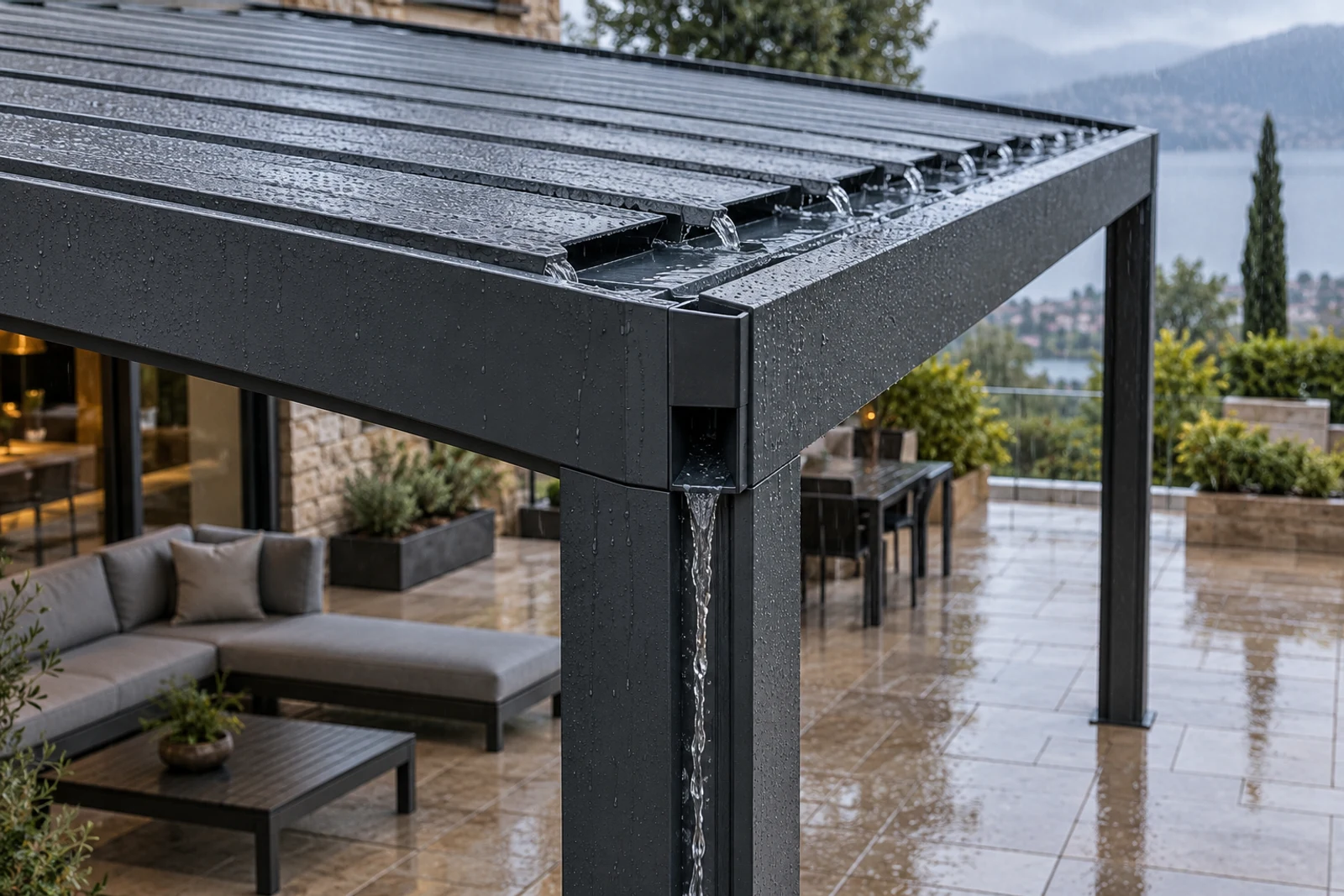
When compatible louvers close, their channels guide ordinary rainwater toward perimeter gutters. The gutters then direct water to selected hollow posts or dedicated outlets, where it must connect to a suitable site discharge. Good drainage depends on the complete route: roof geometry, gutter capacity, post selection, outlet detail, site falls and regular cleaning all matter.
Best for
- Buyers comparing louvered-roof water management
- Architects coordinating post and outlet locations
- Installers preparing slabs and underground drainage
- Hospitality projects protecting doors and circulation
Key information
Key specifications
- Collection
- Closed louver channels and perimeter gutters
- Vertical route
- Selected drainage posts or approved external outlets
- Site interface
- Verified surface discharge or connected stormwater route
- Maintenance
- Accessible gutters, outlets and discharge points
Available options
- Drainage through selected posts
- Project-specific outlet direction
- Connection to an approved site drain
- Multiple roof zones with coordinated outlets
Quick comparison
| Part | Function | What to confirm |
|---|---|---|
| Louvers | Collect and move water when closed | Correct closing position and clean channels |
| Gutters | Receive water around the roof perimeter | Capacity, falls and accessible cleaning |
| Posts | Carry water down selected routes | Which posts drain and where they terminate |
| Site drainage | Moves water away from the occupied area | Legal discharge point, levels and overflow strategy |
Follow the water from roof to ground
A drainage claim is only useful when the whole path is defined. Water first lands on the blades, crosses the louver channels and enters the frame gutter. From there it travels to one or more outlets and down selected posts. The final step is outside the pergola: water must leave the post without flowing across a doorway, pooling around an anchor or creating a slippery route.
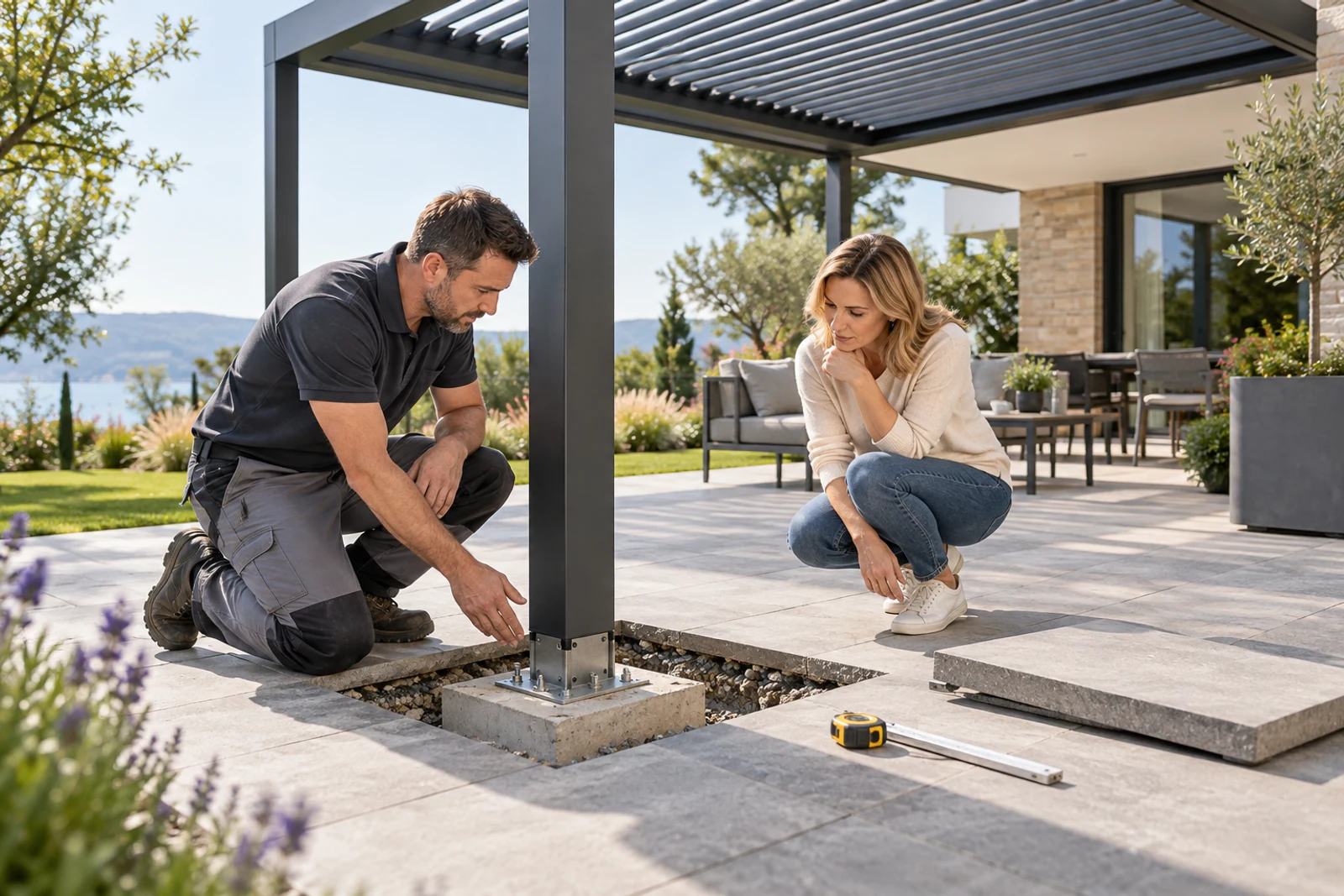
Before production, the approved plan should identify the roof falls, drainage posts and outlet direction. The site team should then coordinate finished levels, underground services and the receiving drain. Do not assume every post drains or that a post can discharge in any direction after fabrication.
- Mark each drainage post on the plan
- Confirm finished paving levels at every base
- Keep outlets away from doors and primary walkways
- Provide access for cleaning and inspection
Why a closed roof can still drip
A louvered pergola remains an outdoor system. Water can enter while the blades are moving, during wind-driven rain or when debris prevents complete closure. Residual water may also remain on the blades and release when the roof reopens. Installation tolerance, seals, module joints and adjacent wall interfaces affect the result.
The correct expectation is managed ordinary rainfall according to the selected system and project conditions, not an unconditional promise of indoor-level waterproofing. Attached layouts also need a separate, verified building-interface detail; the pergola gutter does not automatically waterproof the existing façade.
| Observed issue | Possible area to inspect | Responsible follow-up |
|---|---|---|
| Overflow at roof edge | Blocked outlet, heavy rainfall or incorrect level | Installer and drainage designer |
| Drip at module joint | Joint seal, alignment or movement | Qualified pergola installer |
| Water near post base | Outlet direction or site drain | Installer and site contractor |
| Leak at wall | Flashing and building interface | Responsible building professional |
Coordinate capacity without inventing a universal number
Required drainage capacity depends on roof area, module arrangement, local rainfall intensity, outlet count and the site connection. A rate quoted for one test or configuration should not be applied automatically to another project. LUCY should confirm available system data for the selected model, while the responsible local team checks the design rainfall and final discharge route.
Large connected roofs deserve particular attention because water may concentrate at shared beams or posts. Separating the roof into drainage zones can make the route clearer, but the final arrangement must be shown on approved drawings.
Maintenance protects drainage performance
Leaves, dust, pollen and construction debris can restrict channels and outlets. Inspect safely before wet seasons and after nearby work or severe weather. Use compatible cleaning methods and never place hands near moving blades while the system is energized.
If water behavior changes, stop treating it as a cosmetic issue. Record photographs and operating conditions, check accessible debris points and ask a qualified installer to review alignment, seals and discharge. Persistent overflow can affect finishes, anchors and adjacent construction.
- Keep blade channels and perimeter gutters clear
- Check the visible discharge point
- Retain safe access to drains and service areas
- Document recurring overflow or leakage before repair
Project visuals
See the details in context

Common questions
Do all pergola posts carry rainwater?+
No. Drainage normally uses selected posts shown on the approved layout.
Can the post drain onto paving?+
Only when the discharge location, surface falls and local rules make that appropriate; otherwise connect it to an approved site drainage route.
Why does water fall when the louvers reopen?+
Residual water can remain on blade surfaces after rain and release as the roof changes position.
Is a louvered pergola completely waterproof?+
It is an outdoor rain-management system. Actual performance depends on the product, installation, drainage, maintenance and weather conditions.
About LUCY
Manufacturer-focused guidance from LUCY.
This guide addresses how does a louvered pergola drain rainwater from the perspective of a configurable aluminum pergola manufacturer. Product selection, OEM / ODM and project coordination remain tied to verified site and technical inputs.
For product information, catalogues or a factory quote, contact LUCY on WeChat: Lu260920
Learn about LUCY manufacturing →Project configuration review
Discuss your pergola project with LUCY.
If this how does a louvered pergola drain rainwater guide matches your project question, send the location, dimensions and intended use for a project-specific review.
Get a quote