
- Condensation is moisture from air; leakage is water entering through or around the assembly.
- More glass can reduce natural ventilation and raise internal humidity.
- Heating without ventilation may warm the air while leaving glass surfaces cold.
- Tracks need drainage even when the glass itself is not leaking.
- A pergola glass enclosure should not be described as airtight or thermally insulated unless it was designed and verified that way.
Condensation versus rain leakage
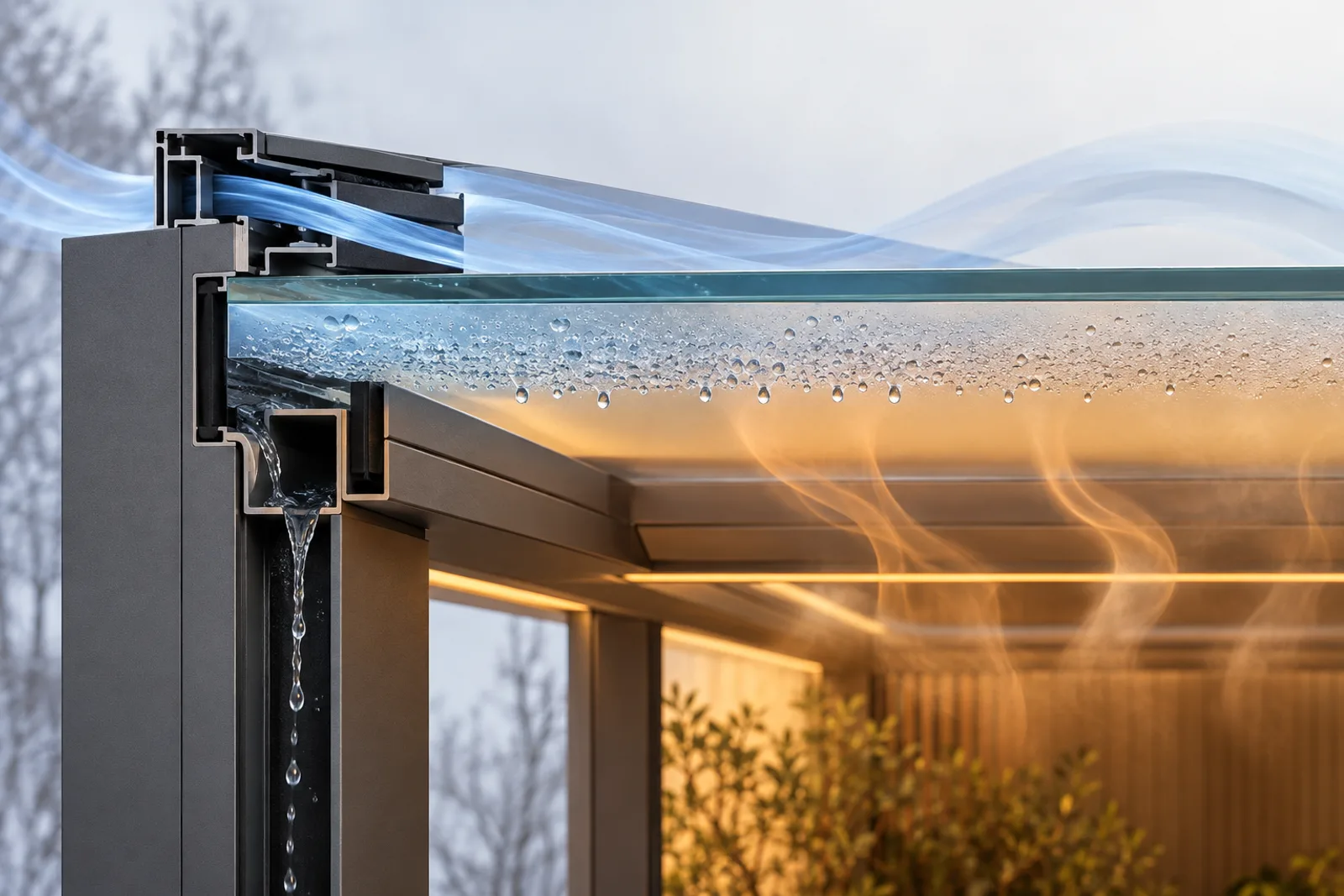
Condensation usually appears as fine droplets, misting or water films on the room-facing side of cool glass. It may be strongest early in the morning, after a temperature drop or when the enclosure has been occupied with little ventilation. Rain leakage follows a different pattern: water enters at a joint, seal, track, threshold, roof interface or overflow point during or after rainfall.
Start by drying the area and observing when and where water returns. Check both sides of the glass, the head and floor tracks, corners and nearby roof drainage. A single photograph is rarely enough. Record outside weather, whether the roof and glass were open or closed, heating use and any wet cleaning, cooking or pool conditions.
| Observation | More consistent with condensation | More consistent with leakage |
|---|---|---|
| Timing | Cold morning or after occupancy | During or shortly after rain |
| Pattern | Mist or droplets across a cool surface | Localized path from joint, head or threshold |
| Weather | Can occur without rain | Usually linked to rainfall or washing |
| First check | Humidity, ventilation and surface temperature | Seals, tracks, drainage and roof interfaces |
Why glass condenses
Air always carries some water vapor. When humid air reaches a surface below its dew point, vapor changes into liquid droplets. Glass often becomes the first visible surface because it responds quickly to outdoor temperature. Aluminum frames and tracks may also cool and collect moisture depending on their construction and exposure.
The important variables are relative humidity, air temperature and surface temperature. They change through the day, so condensation may appear and disappear without any construction change. This guide does not provide a universal dew-point threshold because the real condition requires measured temperature and humidity at the project.
- Warm indoor-side air can hold more moisture
- Cool glass can bring nearby air below its dew point
- Still air allows a cold boundary layer to remain at the glass
- Wet surfaces and occupants add moisture
- Night cooling can create early-morning condensation
Enclosure conditions that increase moisture
Closing sliding or folding glass reduces uncontrolled airflow. That can improve comfort in some conditions, but it also slows moisture removal. Wet paving, a nearby pool, plants, damp furniture, cooking and many occupants can raise humidity. A louvered roof may also be closed during rain, reducing the open area above.
Treat the pergola as an outdoor enclosure unless its complete thermal and air-control system was designed otherwise. Gaps, tracks and roof interfaces can allow outdoor air and water. Adding glass does not automatically provide insulated walls, conditioned-room performance or code compliance for habitable space.
| Moisture source | What to observe | Possible response |
|---|---|---|
| Wet paving or pool | Evaporation after rain or use | Drain standing water and ventilate |
| Occupancy | Condensation after gatherings | Open planned vents or panels |
| Cooking | Steam, smoke and grease | Use suitable ventilation and appliance guidance |
| Heating | Warm air with cold glass | Combine controlled heat with air movement and ventilation |
| Plants or stored fabrics | Persistent local humidity | Reduce moisture sources and improve drying |
Sliding glass, folding glass and panel parking
Sliding systems usually retain overlapping panel paths, while folding systems need hinges, carriers and a clear parking zone. Both need final openings measured from a level, square pergola frame. Their seals and meeting edges should be understood as part of the selected system rather than assumed to match an indoor façade.
Create a repeatable ventilation position that users can operate safely. That may involve opening selected panels, preserving a high-level roof opening or following a site-specific ventilation design. Do not block required exits or rely on an unsecured panel position during wind. The local designer should review glazing safety, manifestation and egress requirements.
- Confirm which panels open and where they park
- Keep the ventilation route understandable to users
- Protect doors and exits
- Allow access for glass and hardware cleaning
- Record safe operating positions for wind and rain
Drainage around glass tracks
A floor track can receive wind-driven rain, cleaning water and condensation running down the glass. Its drainage path must remain clear and lead to an accepted location. Paving falls, thresholds and sealant can accidentally trap water around the track even when the panel system is working as intended.
Inspect weep points and channels without enlarging or modifying them unless the system supplier approves the change. Keep debris out of tracks and verify that pergola roof water does not discharge directly into a glass threshold. Building drainage, pergola post drainage and glass-track drainage are related but separate paths.
- Keep track channels and outlets clean
- Do not bury drainage behind new flooring
- Separate roof discharge from the glass threshold
- Check low points after paving changes
- Investigate overflow before adding more sealant
Heating and air movement
A heater can improve comfort but does not remove moisture by itself. Warming air may increase its moisture capacity while the glass remains cold, so droplets can still form when warm humid air reaches the surface. A fan can help mix air, but its position, speed and effect depend on the layout.
Use heating, ventilation and air movement as one operating strategy. Follow the selected heater and fan instructions, maintain required clearances and have a qualified electrician design the supply. Never use an outdoor pergola enclosure as though it were a sealed conditioned room without a separate building-services and regulatory review.
| Action | Can help by | Limit |
|---|---|---|
| Open selected panels | Releasing humid air | Weather and security must allow it |
| Open louvers | Increasing high-level airflow | Rain and wind conditions govern operation |
| Use a fan | Mixing still air near glass | Does not remove moisture unless air is exchanged |
| Use a heater | Improving local comfort and surface conditions | Does not guarantee dry glass |
What to check on site
Create a short record before requesting service: note the time, weather, glass elevations affected, roof and panel positions, occupancy and heating state. Photograph the full elevation and close details. Dry the track, then observe whether water returns from the glass surface, an upper joint or a drainage path.
If there is persistent leakage, damaged glass, loose hardware, electrical exposure or unsafe movement, restrict use and contact a qualified installer. LUCY can review the pergola and accessory configuration when supplied with the model, drawing revision, measured opening and clear evidence. Local glazing, waterproofing and building-envelope diagnosis remain with the responsible specialists.
- Inside or outside glass surface
- Weather and time of occurrence
- Roof, panel and ventilation position
- Track and threshold drainage condition
- Nearby moisture sources
- Model, order and drawing reference
Project visuals
See the details in context
Common questions
Is condensation proof that the glass leaks?+
No. Condensation can form from humid air on a cold surface without water entering through the assembly.
Will adding more sealant stop condensation?+
No. Extra sealant can block drainage and does not address humidity or surface temperature.
Does glass make a pergola fully sealed?+
Not automatically. Sliding or folding pergola glass should not be treated as an airtight insulated wall unless the full assembly was designed and verified for that purpose.
Can a heater prevent condensation?+
It may change comfort and surface conditions, but ventilation, humidity and glass temperature still matter.
Why is condensation worse in the morning?+
Glass can cool overnight while moisture remains in the enclosure, making early morning a common time for droplets to appear.
What information should I send for review?+
Send the pergola and glass system reference, photographs, affected elevations, weather, panel positions, drainage condition and any measured temperature or humidity data.
Project configuration review
Talk to LUCY About Your Pergola Project
Send your project location, approximate dimensions, site photos or drawings for an initial configuration review.
WeChat: Lu260920
WhatsApp: +86 180 0306 4201
Project configuration review
Discuss your pergola project with LUCY.
Share the site location, dimensions, intended use and any available drawings. LUCY will review the relevant system, model and project interfaces.
Get a quote