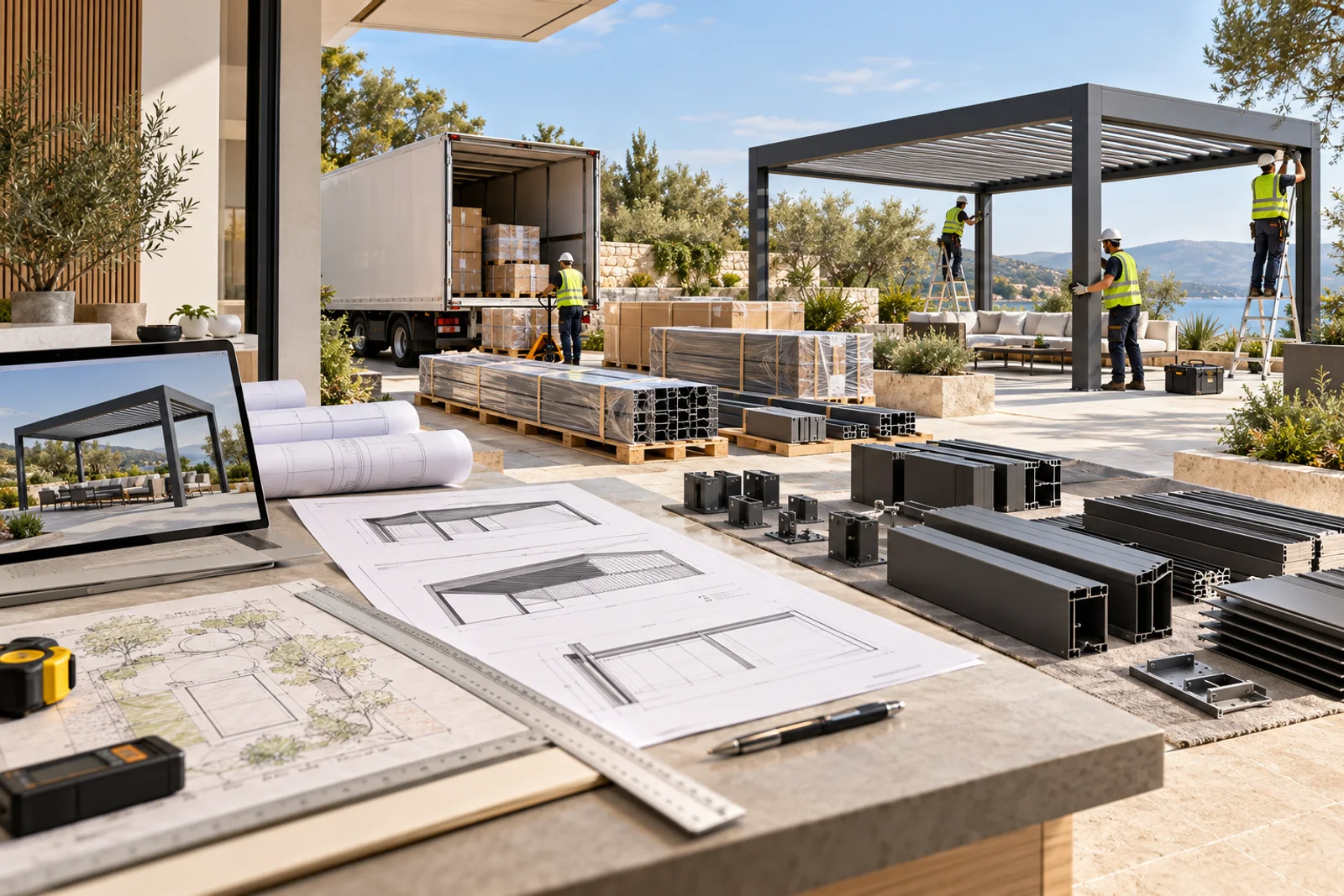
- Separate preconstruction, factory, logistics and site phases.
- Do not start production from unverified dimensions or unresolved supports.
- Run permits, foundations and electrical preparation in parallel only when responsibility is clear.
- Confirm access, lifting, storage and weather constraints before delivery.
- Allow time for testing, drainage checks, controls and handover records.
Best for
- Owners planning a realistic completion date
- Contractors sequencing local works and delivery
- Dealers coordinating imported pergola systems
- Commercial teams planning phased outdoor areas
Key information
Key specifications
- Preconstruction
- Survey, brief, engineering interfaces and approvals
- Factory
- Approved drawings, materials, machining, finish, assembly checks and packing
- Logistics
- Freight booking, customs, destination handling and receiving
- Site
- Foundations, power, lifting, assembly, commissioning and handover
Available options
- Freestanding or attached installation
- Single or multi-module delivery
- Roof, screen, glass and lighting commissioning
- Phased packing and installation where agreed
Quick comparison
| Phase | Cannot start until | Typical completion evidence |
|---|---|---|
| Design | Survey and project brief | Approved layout and interface list |
| Production | Drawing, finish and option approval | Inspection and release records |
| Delivery | Packing and destination plan | Pack list and shipping documents |
| Installation | Supports, access and services ready | Aligned structure and completed connections |
| Handover | Testing and corrections complete | Operation and maintenance records |
Build the programme around approval gates
A useful timeline shows decisions and prerequisites, not only dates. Survey information must be stable before the layout is approved. The layout, finish, roof, controls and accessories must be approved before production. Foundations, access and power must be ready before installation.
Record who approves each gate and what evidence closes it. Starting a later phase early can save time only when the unresolved information cannot change the work already released.
- Site and dimension confirmation
- Structural and building-interface review
- Color, model and accessory approval
- Production release
- Shipment release
- Site readiness
- Commissioning and handover
Preconstruction often controls the real start date
Measure widths, projections, diagonals, heights, finished levels, doors, drains, services and delivery routes. Identify foundations, building attachments, wind or snow criteria and local approval requirements. Approximate information can support budgeting, but production dimensions require a named responsible verifier.
For attached, rooftop or commercial projects, coordination may involve the architect, structural professional, roofing trade, electrician, contractor and authority. Put these reviews into the programme instead of treating them as last-minute site tasks.
| Input | Owner | Programme risk if missing |
|---|---|---|
| Final dimensions | Surveyor or responsible contractor | Incorrect profiles or opening sizes |
| Support design | Local qualified professional | Unapproved bases or attachments |
| Electrical plan | Qualified local trade | No supply or incompatible routing |
| Access plan | Contractor or lifting specialist | Delivery cannot reach the work area |
Production begins after controlled approval
Manufacturing can include material preparation, machining, finish, component assembly, functional checks, identification and packing. Custom colors, revised dimensions, special accessories or changed labels can alter the sequence. Ask the supplier to state which approval starts the factory lead time.
Before shipment, compare the packed order with the approved drawing and option schedule. Confirm motors, controls, hardware, accessories, spare items, package marks and documents. Freight should not be booked against an unapproved release.
- Use one final drawing revision
- Freeze the option and control schedule
- Confirm finish and visible hardware
- Record inspection and correction status
- Match package marks to the installation sequence
Transport and site preparation should be coordinated
Transit time depends on origin, destination, transport mode, customs and final delivery conditions. Long profiles, glass and accessory packs may need specific unloading equipment and dry protected storage. Confirm package dimensions and receiving responsibility before dispatch.
Foundations, anchors, power, drainage discharge, access and work-zone protection should be ready before the installation crew mobilizes. If wet trades or finished surfaces are incomplete, installation may stop even when the pergola arrives on time.
| Site prerequisite | Confirm before delivery |
|---|---|
| Supports | Location, level, strength and approved anchors |
| Access | Vehicle, unloading, lift and carrying route |
| Storage | Dry protected area and package sequence |
| Services | Power, controls and drainage interfaces |
| Safety | Work-at-height, exclusion and weather plan |
Installation ends with commissioning, not the last bolt
After the frame and roof are aligned, installers may need to connect controls, set limits, test movement, verify drainage, adjust screens or glass and complete sealant or interface work. Qualified local trades handle regulated electrical and structural work according to the project requirements.
Handover should identify control zones, isolation points, operating limits, weather procedures, cleaning, maintenance and support contacts. LUCY can review the product and documentation inputs for a project timeline; use the quote form or WeChat: Lu260920.
- Alignment and fastener checks
- Roof, screen and glass operation
- Control-zone and limit testing
- Drainage observation
- Cleaning and protection removal
- Operation and maintenance handover
Project visuals
See the details in context


Common questions
How long does it take to install a pergola?+
On-site assembly duration depends on size, modules, access, foundations, accessories, crew and weather. The supplier or installer should programme the actual project rather than promise a universal number.
How long does a motorized pergola project take?+
The complete duration includes survey, approval, production, transport, site preparation, installation and commissioning. Ask for a phase-by-phase programme.
Can foundations be built while the pergola is manufactured?+
Sometimes, but only after post reactions, locations, levels and anchor details are approved and controlled against the same drawing revision.
What delays pergola installation?+
Unverified dimensions, unresolved supports, permits, color or accessory changes, incomplete power, restricted access, shipping events and unsuitable weather can all affect the programme.
What should be ready before the pergola arrives?+
Approved supports, access, unloading equipment, storage, power and drainage interfaces, work-zone protection and the current installation documents.
About LUCY
Aluminum pergola systems for project buyers.
LUCY manufactures configurable aluminum pergola systems for residential, hospitality and commercial projects.
Project configuration review
Discuss your pergola project with LUCY.
Share the site location, dimensions, intended use and any available drawings. LUCY will review the relevant system, model and project interfaces.
Get a quote