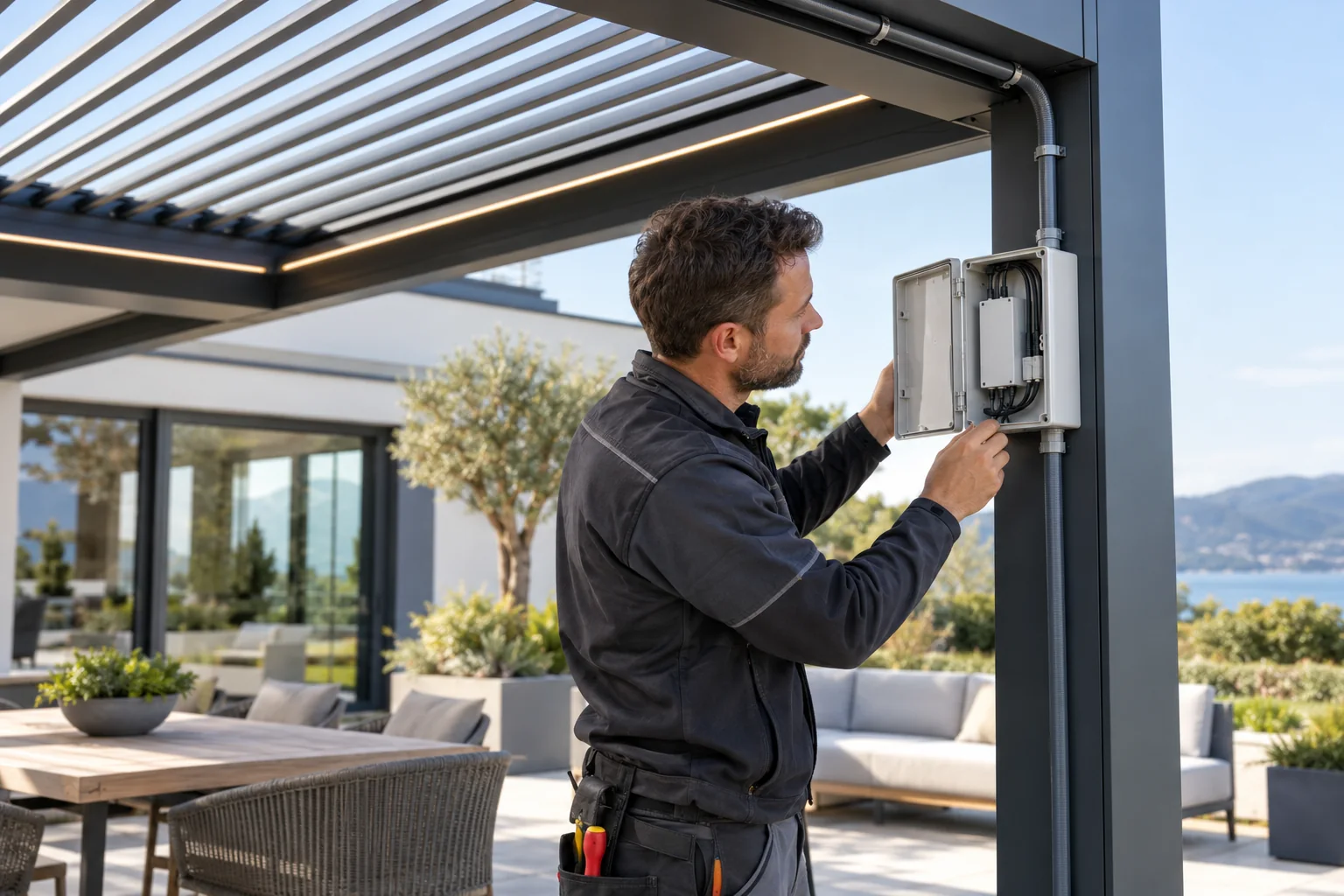
There is no safe universal voltage or circuit answer for every motorized pergola. The required supply comes from the actual motor, controller, lighting and accessory schedule selected for the order. A qualified local electrician should use the verified equipment data to design the circuit, isolation, protection, weather-rated enclosures, cable route and final connection under the locally adopted electrical rules.
Best for
- Electricians preparing a supply route
- Architects coordinating concealed services
- Dealers checking market compatibility
- Hospitality operators planning multiple control zones
Key information
Key specifications
- Supply
- Confirmed from the ordered motor and controller data
- Loads
- Roof zones, screens, lighting, sensors and accessories listed separately
- Protection
- Designed by the local electrician for outdoor conditions
- Access
- Isolation and controls remain identifiable and serviceable
Available options
- Local wall control
- Compatible remote control
- Approved weather-sensor input
- Compatible building-control interface
Quick comparison
| Item | Confirm before production | Confirm on site |
|---|---|---|
| Roof motor | Model, voltage and controller | Circuit and connection |
| ZIP screens | Number and compatible controls | Cable routes and isolation |
| LED lighting | Driver and control method | Access and switching |
| Sensors | Approved compatibility and logic | Location and commissioning |
Build an equipment schedule before choosing the circuit
A single pergola can include more than one roof motor, independently controlled ZIP screens, lighting drivers, sensors and other approved accessories. Their data must come from the final order, not a generic internet diagram. Record model references, rated input, control equipment and zone grouping in one schedule.
LUCY can provide available product information for supplied components. The local electrician remains responsible for cable sizing, circuit protection, earthing or bonding where applicable, isolation and compliance with the adopted rules and site conditions.
- Separate roof, screen and lighting loads
- Confirm local supply compatibility before ordering
- Identify every driver, receiver and controller
- Keep approved documents with the distribution-board schedule
Treat the outdoor route as a design interface
A roofed terrace is not automatically a dry indoor electrical location. Moisture, condensation, wind-driven rain, washdown and water inside outdoor raceways can affect the specification. Use equipment and wiring methods selected by the responsible electrician for the actual damp or wet exposure.
Plan the cable path before profiles are fabricated. Concealed routes must avoid drainage channels, moving linkages, anchor drilling and sharp edges. Provide grommets, strain relief, accessible junctions and service loops only where the approved component and electrical design require them.
| Interface | Question | Failure avoided |
|---|---|---|
| Beam and post | Where is the approved cable route? | Conflict with drains or moving parts |
| Controller | Can it be isolated and serviced? | Unsafe or destructive maintenance |
| Roof-to-building | How is the penetration weathered? | Water entry and cable damage |
| Accessory zones | Are controls correctly grouped? | Unexpected simultaneous operation |
Controls and sensors require commissioning
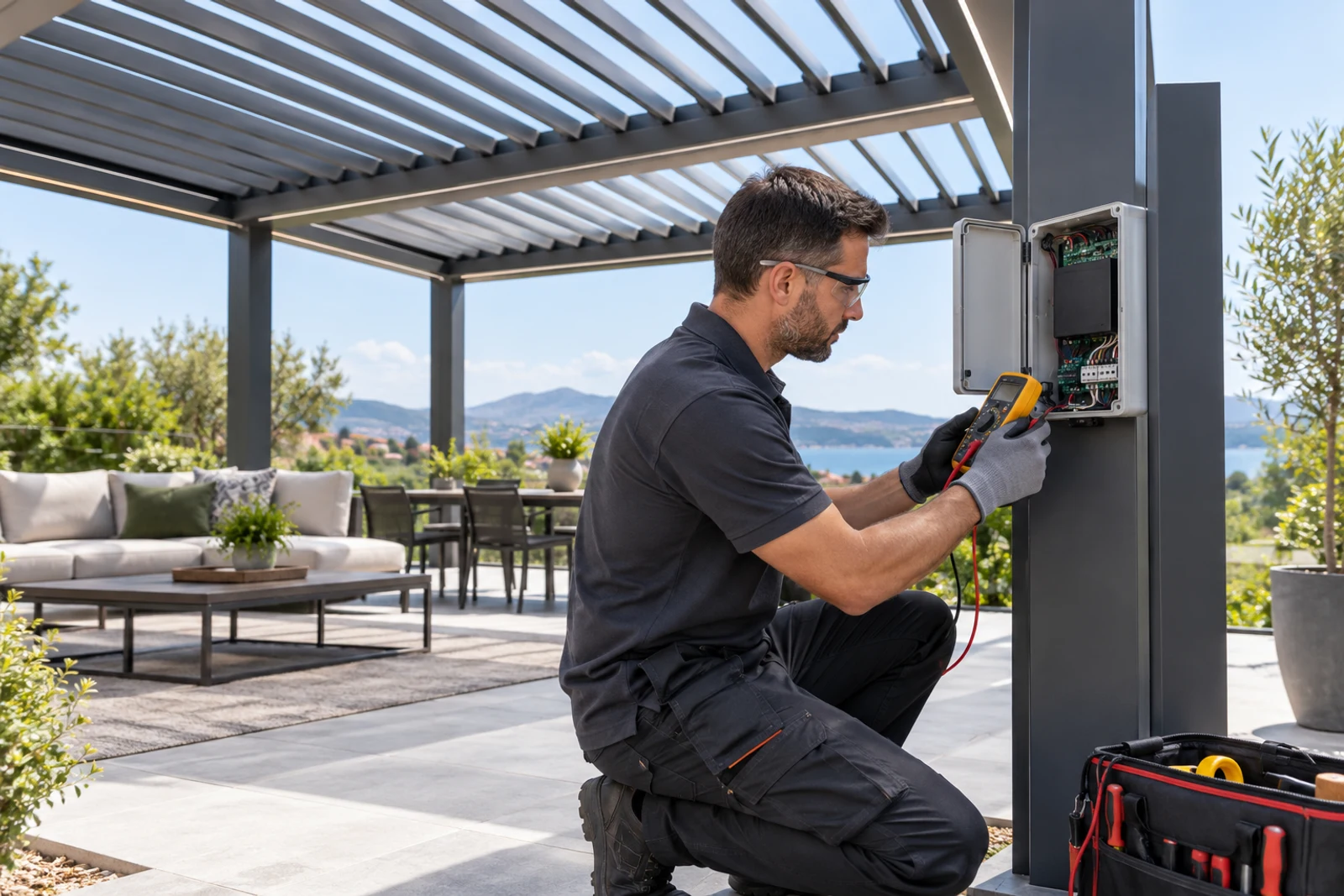
A compatible rain or wind sensor is not useful until it is assigned to the intended zones, positioned correctly and tested. Confirm motor direction, travel limits, obstruction procedures and the response of every control method. Do not assume that a smart-home relay can be connected directly to a pergola controller without written compatibility.
Commercial projects should keep a simple operating record showing isolators, roof zones, screen zones, remotes and severe-weather procedures. Staff should know what automation can do and where manual supervision is still required.
Send these details with the quote request
State the installation country, available supply, intended roof and accessory zones, desired controls and whether the project has a nominated electrician or building-control system. Mark the preferred supply entry and controller location on the plan, but allow them to be reviewed against drainage and structure.
Final electrical installation, testing and certification must be completed by appropriately qualified local personnel. Never energize unverified equipment or change protection devices to overcome repeated trips.
Project visuals
See the details in context
Common questions
Are all pergola motors 24 V?+
No. Motor and controller arrangements vary, so use the verified data for the supplied system.
Can one circuit power the roof, screens and lights?+
Only the responsible electrician can decide after reviewing all loads, controls and local rules.
Can cables run inside drainage posts?+
Only when the specific profile design and approved routing keep electrical and drainage functions safely separated.
Does a rain sensor work during a power outage?+
A sensor cannot move the roof when the required controller or motor power is unavailable.
About LUCY
Manufacturer-focused guidance from LUCY.
This guide addresses what power supply does a motorized pergola need from the perspective of a configurable aluminum pergola manufacturer. Product selection, OEM / ODM and project coordination remain tied to verified site and technical inputs.
For product information, catalogues or a factory quote, contact LUCY on WeChat: Lu260920
Learn about LUCY manufacturing →Project configuration review
Discuss your pergola project with LUCY.
If this what power supply does a motorized pergola need guide matches your project question, send the location, dimensions and intended use for a project-specific review.
Get a quote